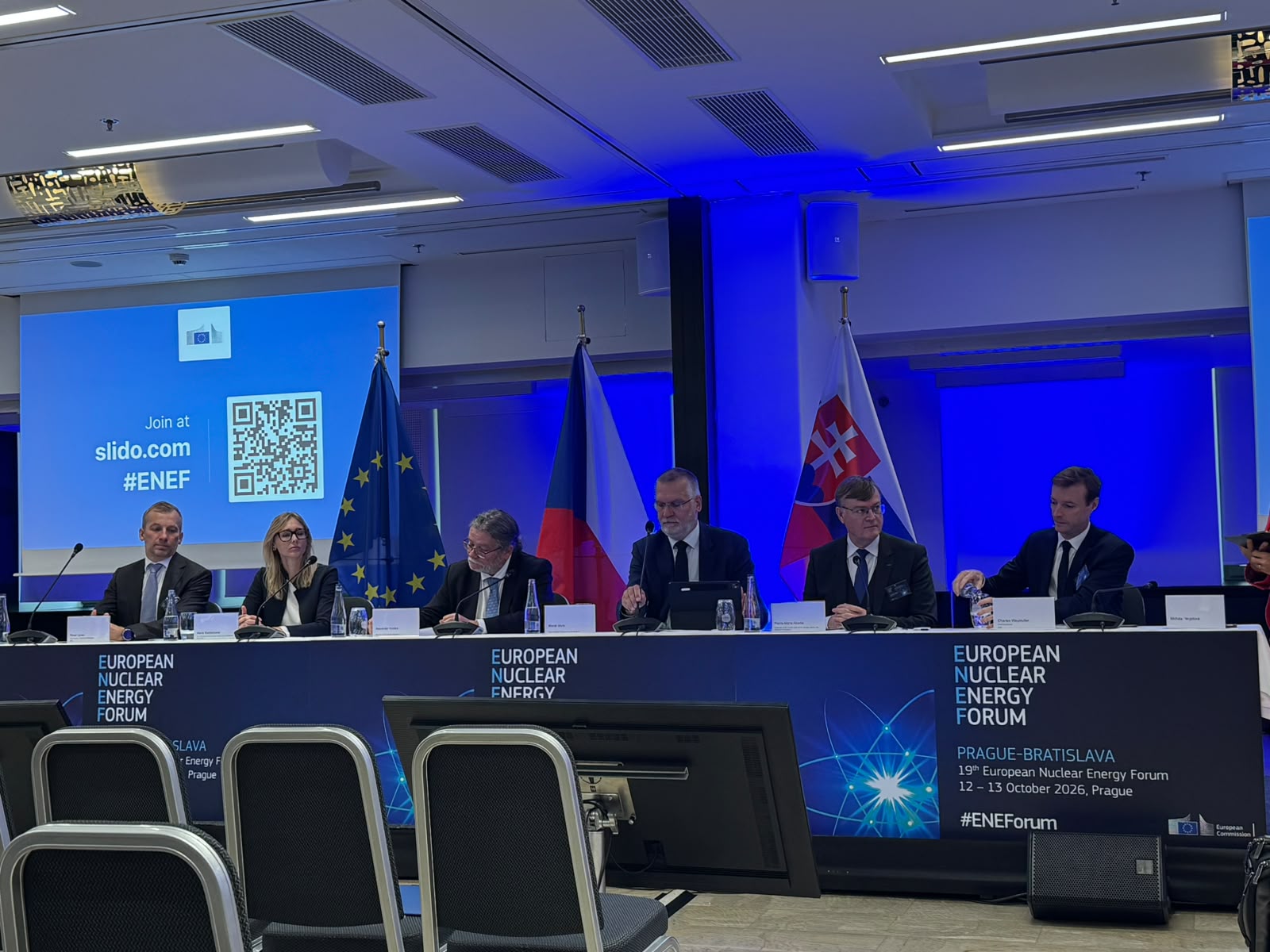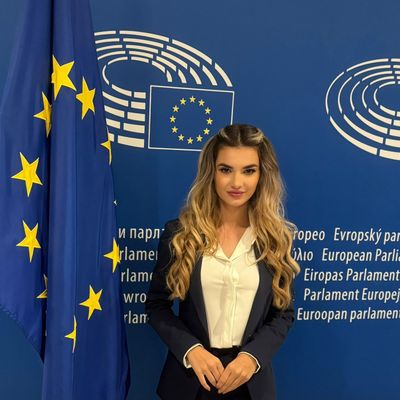
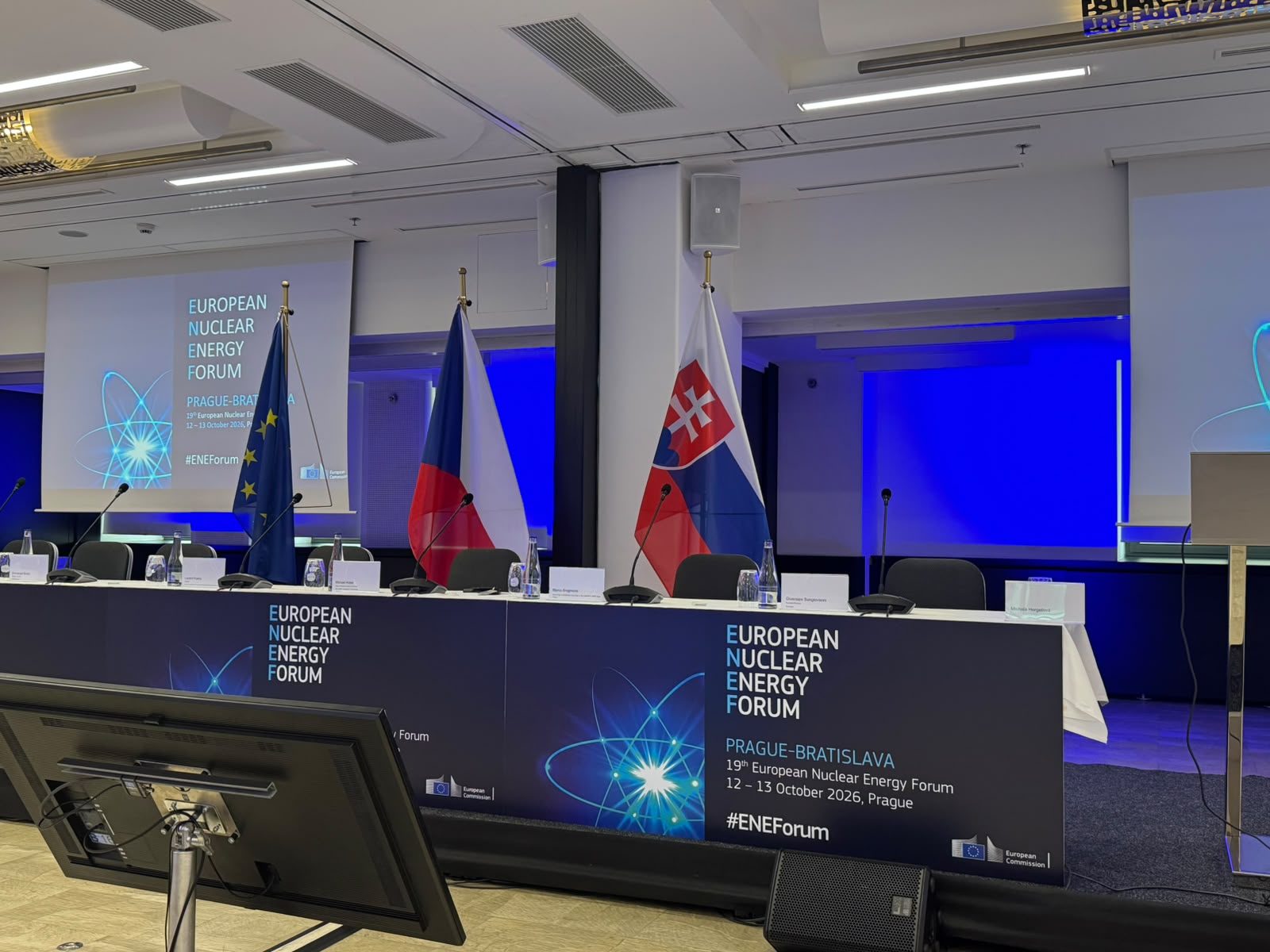
On 12 and 13 October 2026 I took part, as Energy Representative of the European Youth Movement, in the 19th European Nuclear Energy Forum (ENEF) in Prague, organised by the European Commission together with the Czech Republic. This year's edition focused on how to move from announcements to delivery. Over two days, panels and World Café sessions brought together ministers, regulators, industry, financial institutions, civil society and young professionals.
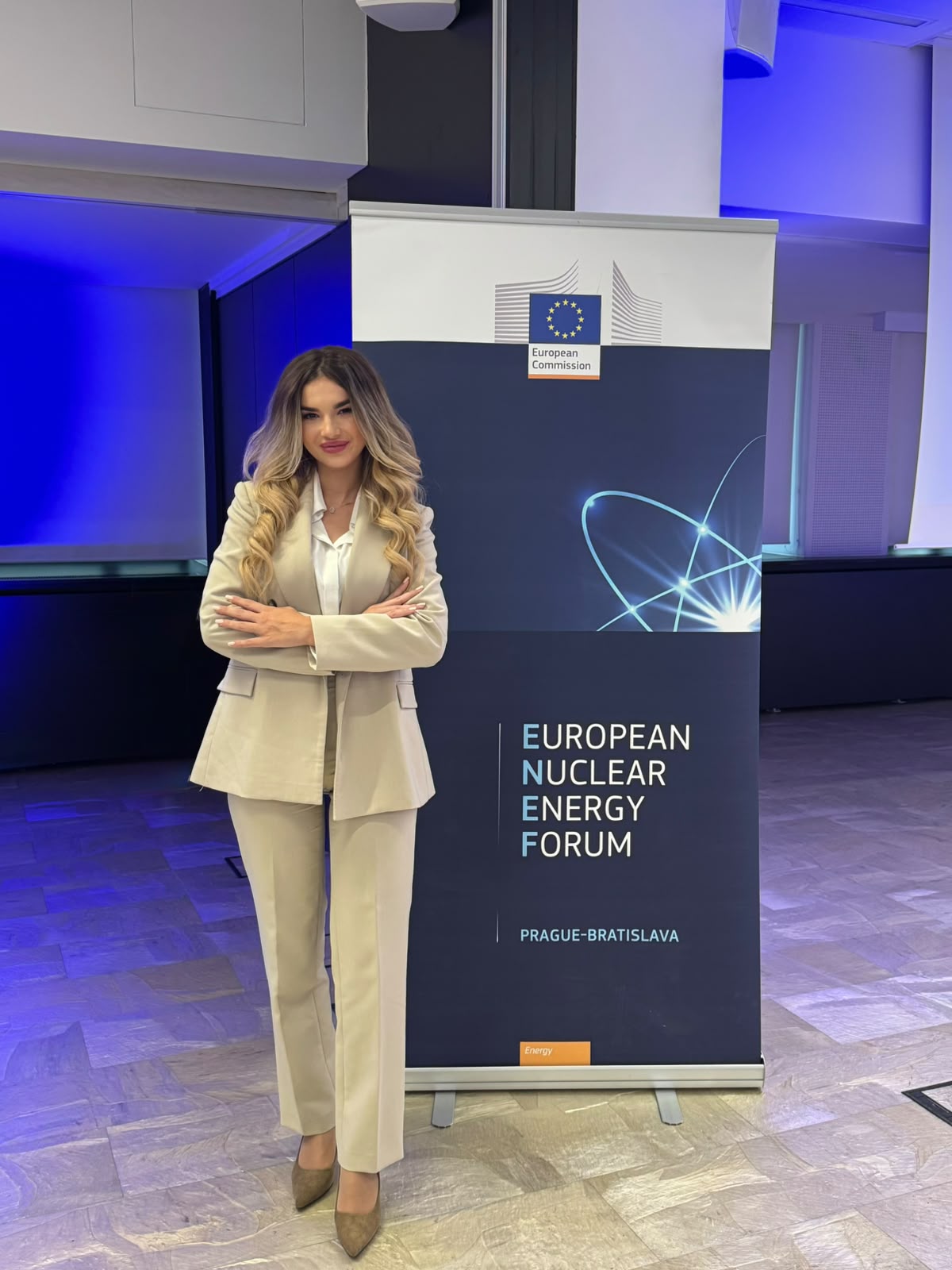
The clearest message of the Forum was that the political debate has changed. Nuclear is now broadly accepted at EU level as part of the answer to decarbonisation, competitiveness and security of supply. This year the Commission adopted the Nuclear Illustrative Programme (PINC), which estimates investment needs of €241 billion by 2050, together with the EU SMR Strategy and the European Radioisotope Valley Initiative. The question raised throughout the Forum was whether Europe can now deliver projects on time, on budget and safely.
However, many participants felt that this political support has not yet reached EU legislation. Speakers pointed to nuclear's "transitional" status in the taxonomy, the post-2030 framework and the national energy and climate plans, access to the next MFF, and state aid decisions that can take more than a year even for repeat cases. Céline Gauer, the Commission's Director-General for Energy, replied that technology neutrality does not mean identical rules for every technology, but rules that fit each one. In my view, the way this principle is translated into concrete legal provisions over the next two or three years will largely decide the pace of new projects.
The same need for stability shaped the discussion on financing, which is above all a question of predictability and risk-sharing. Investors need stable rules over several decades. As EIB Vice-President Marek Mora explained, the bank's involvement matters as much for the signal it sends to private capital as for the money itself. Contracts for difference and power purchase agreements were discussed as the main tools, although he was clear that public resources are limited and governments will have to make choices.
Regulators, for their part, challenged the idea that permitting is the main cause of delay. Pierre-Marie Abadie, Chairman of the French Authority for Nuclear Safety and Radiation Protection (ASNR), noted that past overruns came mainly from immature designs, weak project management and supply chain problems. Joint early reviews between national regulators were presented as the best way to save time without lowering safety, while differences in non-nuclear national rules, such as fire or noise standards, remain an obstacle to standardised SMRs.
Public trust, in turn, depends heavily on the back end of the fuel cycle. Finland's Onkalo repository shows what long-term responsibility and early stakeholder engagement can achieve, and there was strong interest in recycling spent fuel. The Commission is evaluating the Euratom directives on radioactive waste and shipments, and 23 Member States have just set up a forum on joint approaches to waste management. As Céline Gauer put it, nuclear power can only be called clean if the waste question is credibly solved.
Skills were the one topic that came up in every session, even in the World Café on financing, where participants voted them the top investment priority. The Commission estimates that 180,000 to 250,000 new workers will be needed, most of them technicians, welders, electricians and project managers rather than nuclear engineers. Keeping experienced people and making the sector attractive to women and young professionals matters as much as recruiting them.
My overall impression is that the momentum is real, but the next Forum will judge it by signed investment decisions rather than speeches. It was encouraging to see young professionals moderating the World Cafés, yet the political panels were still dominated by senior voices, and support for nuclear remains weaker among younger people. Youth organisations can help here by explaining the full life cycle openly, including waste, and by showing that a career in the sector has a long-term future.